Thought Record
Put the thought on paper and weigh it.
When your mood drops fast, a thought usually got there first. They're annoyed with me. I've ruined it. A thought record is a way to catch that thought, look at the evidence on both sides, and land somewhere more accurate.
Free. No account. Nothing you write leaves your device.
A finished record, shortened
Tuesday, about 2 p.m., at my desk. I asked in the group chat if anyone wanted dinner Friday. An hour later nobody had answered, and it showed that two people had read it.
Embarrassed 70, Lonely 60, Anxious 40. Body: Hot face, heavy stomach.
Nobody really wants me around. 80
- Two people read the message and didn’t answer for an hour.
- I organized the last two dinners.
- It’s a Tuesday afternoon. Sam and Priya are at work until six.
- Priya answered within minutes the last time I asked.
- Sam invited me to his birthday two weeks ago.
- I read messages at work and forget to answer all the time.
Nobody has answered yet, and that stings. It’s also a workday afternoon, Priya usually answers fast, and Sam invited me to his birthday two weeks ago. A slow reply is more likely about their afternoon than about me. 70
Embarrassed 70 → 35, Lonely 60 → 40, Anxious 40 → 20. Hot thought believed 80 → 35.
What it is
A thought record is one of the core tools of cognitive behavioral therapy. You take one moment that upset you and slow it down. What happened, what you felt and how strongly, and what went through your mind. Then you pick the thought that hit hardest and treat it as a claim to be checked, not a fact. What supports it? What doesn't? Taking all of that into account, what is a fairer way to see it, and how do you feel now?
Aaron Beck and his colleagues published the first version in 1979, as part of cognitive therapy for depression. The version most therapists use today comes from Mind Over Mood, which added separate columns for the evidence on each side. The worksheet here follows that approach, with a step to choose the hot thought and one at the end to write down what you noticed.
The point isn't to think positive. Sometimes the evidence mostly supports the worry, and that is useful to know too. The point is to see the situation more accurately, and usually to feel a bit less weighed down by it.
Nine steps
- SituationOne specific moment. Where you were, who was there, what happened. What a camera would have caught.
- FeelingsName each one, usually in a single word, and rate it from 0 to 100.
- Thoughts and imagesEverything that went through your mind, written as statements. "What if they laugh?" becomes "They're going to laugh at me."
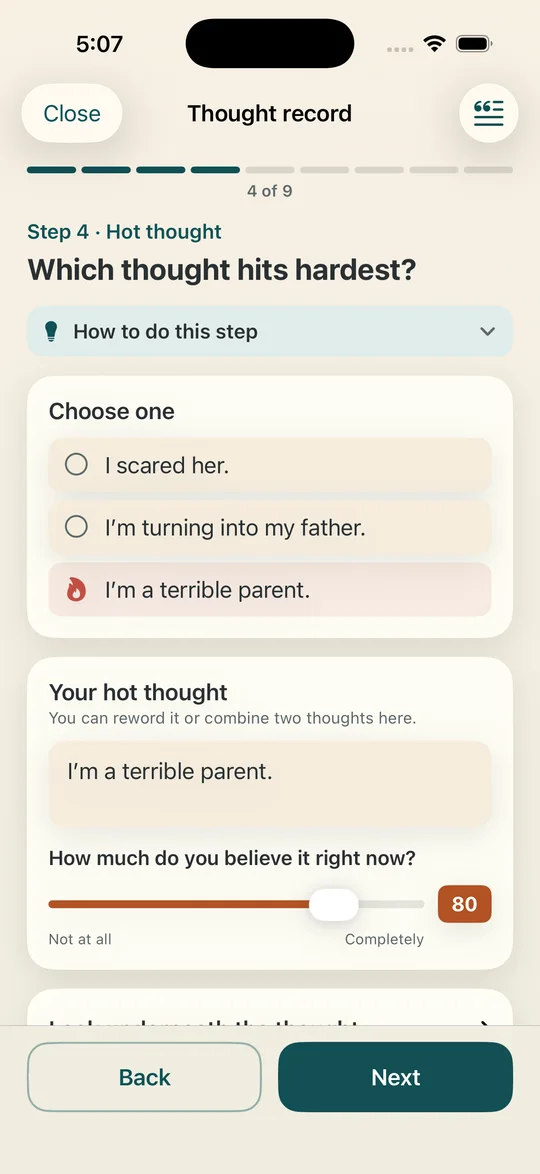
- Hot thoughtThe one that best explains the feeling. Rate how much you believe it.
- Evidence forFacts that support the hot thought. Be fair to it.
- Evidence againstFacts that don't fit, or suggest it isn't the whole story. Usually the hardest step, so there are questions to help.
- Balanced thoughtA thought that takes both lists into account, and one you can actually believe.
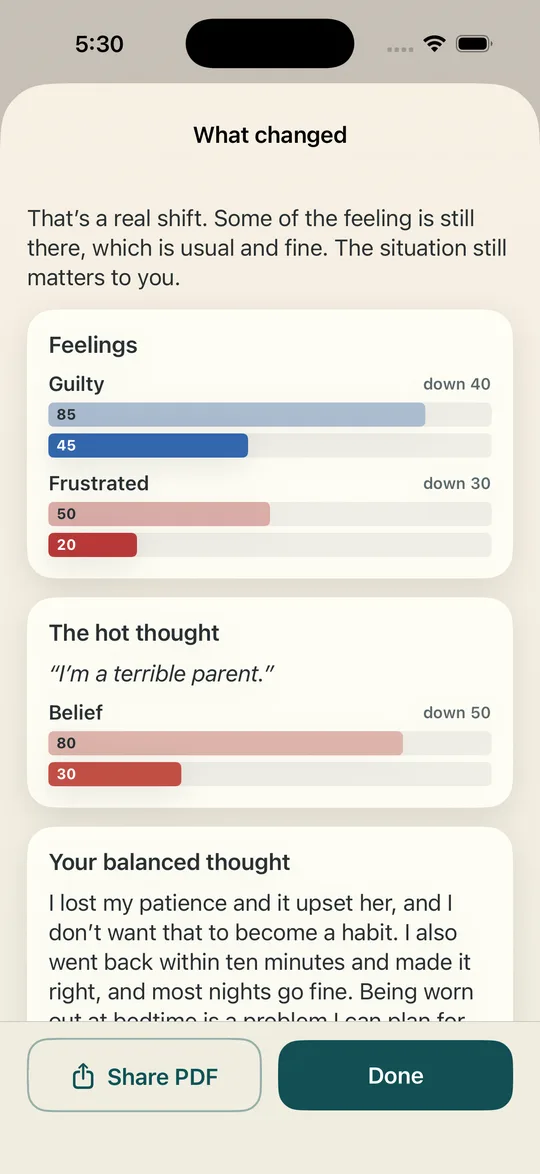
- Feelings nowThe same feelings, rated again. A drop of 20 or 30 points is a good result.
- What I learnedWhat you noticed, and a small next step if there is one.
The full guide, with the mistakes that most often stall a record
Three ways to do one
Online. The web worksheet has the feelings wheel, the guiding questions, and the ratings built in. It saves in your browser on this device and nowhere else, and prints cleanly or saves as a PDF.
On paper or in Word. A fillable PDF, a printable PDF, and a Word document, with a one page guide to go with them.
In the app. Thought Record for iPhone and iPad keeps your records together, lets you jot down the first three parts in a minute and finish later, and makes a summary to bring to therapy.
For therapists
Worksheets you can hand out or send, each with the nine steps, 0 to 100 ratings, and short prompts under every heading. The client guide explains the method in plain language with a worked example on the back.
There are also notes on introducing records in stages, what to look for when a client brings one in, and when a record is the wrong tool, as with reassurance seeking in OCD or health anxiety.
Questions people ask
Isn't this just positive thinking?
No. Positive thinking starts with the conclusion you'd like. A thought record starts with the evidence, and takes the side that supports the worry seriously. A good balanced thought often keeps part of the original, like "I rushed one section and it showed, and one revision doesn't make me bad at my job."
What if the thought turns out to be true?
That happens. The record still helps, because it separates what is true from what the thought adds, like "forever" or "it's all my fault," and it points to what you can do. There's an example of this.
I believe the new thought in my head but not in my gut.
Very common. Rate it anyway, and notice whether it grows over a few days. Testing the thought in real life often works better than more writing, which is what a behavioral experiment is for.
Is this therapy?
No. It's a worksheet and a set of educational articles based on published CBT methods. Many people use thought records between sessions with a therapist, and that is where they work best. If the same worry keeps coming back however often you examine it, or you're dealing with trauma, please talk to a professional. When a record isn't the right tool.
Where does my writing go?
Nowhere. The online worksheet saves in your own browser. The app keeps everything on your phone unless you turn on sync to your own iCloud. We have no server and never see what you write. Privacy.
The app
The same nine steps, in your pocket
Guidance and an example on every step. The feelings wheel for finding the right word. Gentle notes when a thought is written as a question or a guess is listed as evidence. A before and after view at the end, a Patterns screen, and a session summary PDF for your therapist.
No accounts, no ads, no analytics. English and Spanish. Coming soon to iPhone and iPad.